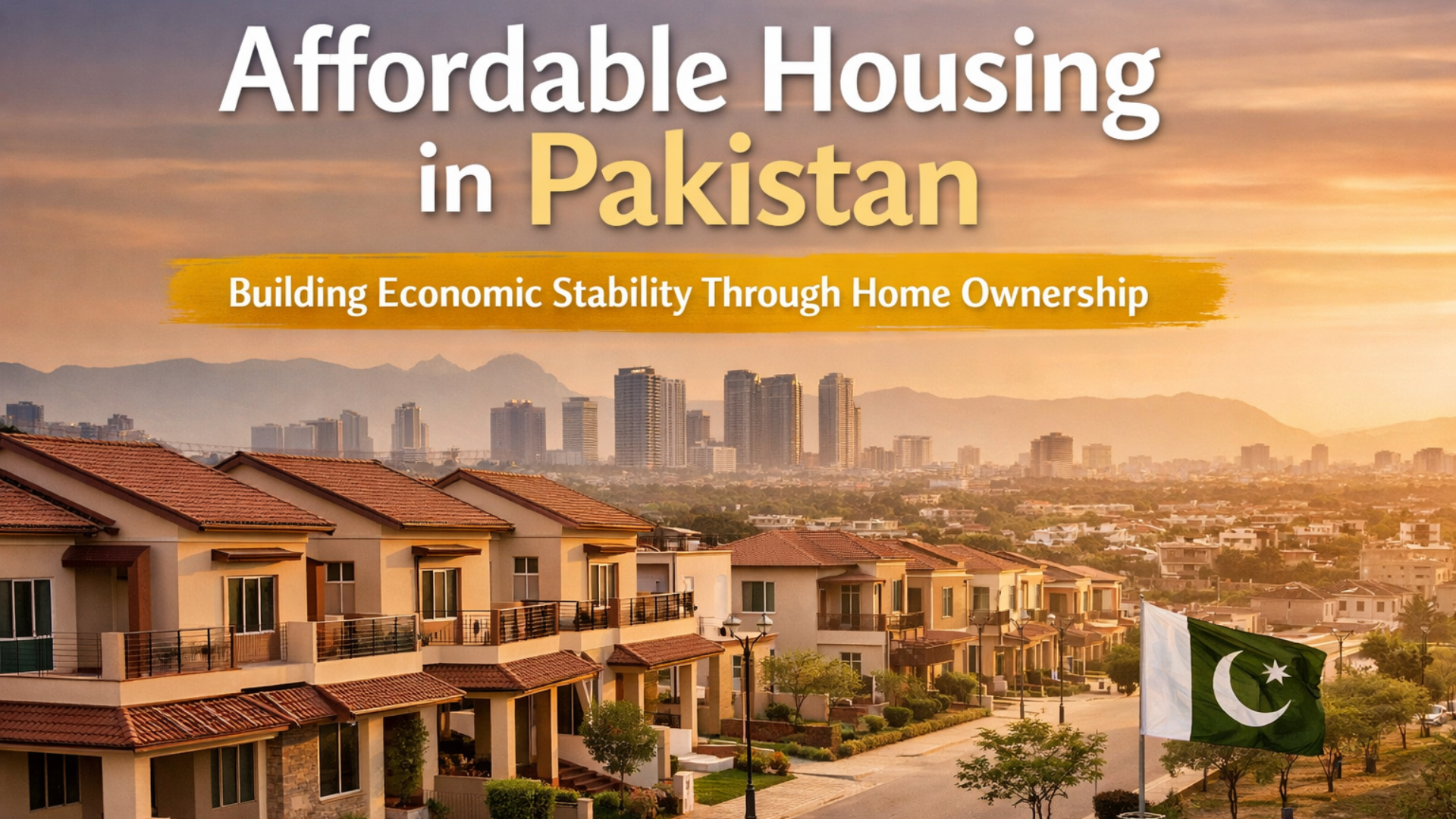

Affordable Housing in Pakistan: Building Economic Stability Through Home Ownership. Providing affordable housing is not just a social promise. It is a long-term economic strategy. Across the world, countries that helped citizens own homes saw stronger economies, stable communities, and better social outcomes. Home ownership gives people security. It also gives them a stake in their country’s future.
For Pakistan, where rapid urbanisation and a large housing shortage continue to challenge millions, affordable housing is more than a policy option. It is a national need. With the right mix of government support, banking innovation, and Shariah-compliant finance, Pakistan can turn housing into a powerful engine of growth and inclusion.
Why Housing Matters Beyond Shelter
Housing is the foundation of stability. When families own homes, their mindset changes. Rent becomes investment. Temporary living turns into long-term planning.
Homeowners are more likely to:
- Maintain and improve their property
- Invest in education and skills
- Participate in neighbourhood life
- Plan for future generations
This shift supports social cohesion. It also strengthens the economy. Stable households support stable labour markets. Communities with permanent residents are safer, more productive, and more resilient during economic shocks.
Global Evidence: Home Ownership Drives Stability
According to data from the Organisation for Economic Co-operation and Development, home ownership remains the norm in advanced economies. On average, 71 percent of households own their homes, either outright or through a mortgage. Only about 24 percent rely on long-term renting.

Countries in Central and Eastern Europe report ownership rates above 70 percent. These figures are not accidental. They are the result of deliberate housing policies, privatisation strategies, and accessible financing.
However, affordability remains a global concern. Since 2010, house prices have grown faster than incomes. In 2024, the OECD housing price-to-income index stood at 116.2, meaning prices have risen over 16 percent faster than earnings since 2015.
Singapore’s Housing Model: A Working Example
One country stands out. Singapore introduced affordable housing as a core national policy soon after independence. Today:
- Over 90 percent of citizens live in supported or subsidised housing
- Home ownership rates are close to 90 percent
- Housing policy is directly linked to economic and social planning
Singapore’s success shows that affordable housing does more than provide shelter. It creates stakeholder-citizens. People who own homes invest more in their communities and the economy. They save more, spend wisely, and plan for the long term.
Housing as an Economic Multiplier
Housing construction stimulates multiple sectors at once:

- Cement and steel
- Plumbing and electrical services
- Architecture and engineering
- Transport and urban services
Each new housing project creates jobs and boosts domestic demand. When housing is affordable, demand rises. This creates a multiplier effect across the economy.
Secure housing also improves productivity. Families with stable homes focus on education, work, and skill development instead of short-term survival. Over time, this builds human capital and strengthens national growth.
Pakistan’s Housing Challenge
Pakistan faces a large and growing housing deficit. Low- and middle-income households struggle most. Many cannot qualify for conventional mortgages due to:
- High interest rates
- Large down-payment requirements
- Short tenures
- Lack of formal credit history
Urbanisation has increased demand. At the same time, access to affordable finance remains limited. Without intervention, the gap continues to widen.
Policy Response: “Mera Ghar, Mera Ashiana”
To address this gap, the State Bank of Pakistan launched Mera Ghar, Mera Ashiana. The scheme aims to:

- Subsidise housing finance
- Share risk with banks
- Encourage lending to underserved groups
- Promote construction and allied industries
This initiative links housing directly with economic growth. It recognises that ownership builds stability, dignity, and long-term wealth.
Role of Banks in Expanding Home Ownership
Local banks play a critical role in turning policy into reality. Among them, Faysal Bank has taken a strategic lead.
The bank introduced Diminishing Musharakah, a Shariah-compliant housing finance model. Under this structure:
- The bank and customer jointly own the property
- The customer pays rent for the bank’s share
- Ownership gradually transfers to the customer
- Full ownership is achieved over time
This approach reduces barriers for low-income families. It allows:
- Longer tenures
- Smaller down-payments
- Flexible eligibility criteria
Partnering for Inclusion: Akhuwat’s Role
To reach the most vulnerable groups, Faysal Bank partnered with Akhuwat. Akhuwat helps identify eligible low-income individuals and supports them through the financing process.

This collaboration shows how banks can serve a dual purpose:
- Fulfil social responsibility
- Expand into underserved markets
Such partnerships are essential for a housing-for-all strategy.
Why Islamic Banking Fits Pakistan’s Housing Needs
Islamic banking holds a strong advantage in Pakistan. Demand for Shariah-compliant products is high. Many families avoid conventional interest-based loans.
Diminishing Musharakah aligns well with local values and economic realities:
- Financing is based on co-ownership, not interest
- Risk is shared between bank and customer
- Payment structures are more flexible
- Entry barriers are lower for first-time buyers
For a national housing strategy, Islamic finance is not optional. It is essential.

Lessons for Pakistan from Global Experience
Countries that succeeded did not just build houses. They built systems:
- Affordable pricing
- Long financing tenures
- Reasonable monthly payments
- Institutional support
- Strong regulation
For Pakistan, this means:
- Banks partnering with regulators and developers
- Products designed for first-time and low-income buyers
- Reduced transaction costs
- Subsidised down-payments
- Strong Shariah-compliant options
When housing is accessible, communities thrive. Homeowners invest locally. Small businesses grow. Generational wealth develops.
Housing, Dignity, and National Resilience
In uncertain economic times, housing provides stability. Ownership gives dignity. It anchors families. It reduces pressure on state welfare. It empowers citizens.
For Pakistan, affordable housing is not just about bricks and mortar. It is a strategic tool for:
- Economic momentum
- Social inclusion
- Long-term resilience
Banks like Faysal Bank that act today are not only serving a market. They are shaping the future. By enabling more Pakistanis to own homes, they help build a more stable, inclusive, and progressive economy.
Conclusion
A home for every citizen is not an idealistic slogan. It is an achievable goal. With smart policy, inclusive finance, and strong partnerships, Pakistan can transform housing into a driver of growth and stability. Affordable housing builds owners, not dependents. It builds communities, not just structures. And most importantly, it builds a future where every citizen has a place to belong.