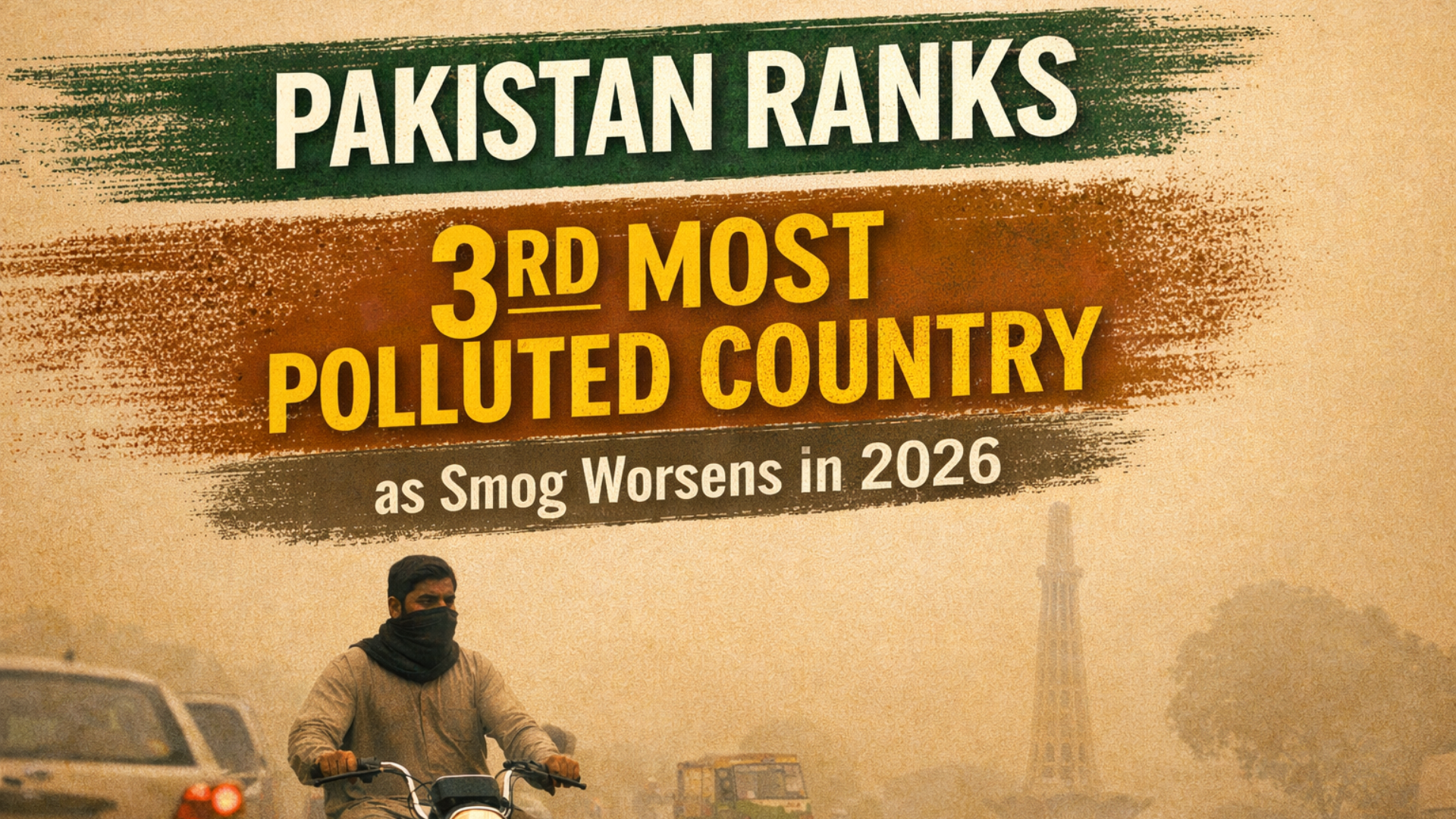

Ranks 3rd Most Polluted Country as Smog. Pakistan is facing a worsening air pollution emergency. Recent data places the country as the third most polluted in the world, with average PM2.5 levels at 73.7 micrograms per cubic metre. This figure is far above the safe limits recommended by global health experts and highlights a growing public health and environmental challenge.
Air quality conditions are especially alarming in major urban centres. Cities like Lahore experience extreme smog episodes every winter, disrupting daily life, damaging health, and increasing economic costs.
What PM2.5 Levels Reveal About Pakistan Air
PM2.5 refers to fine particulate matter small enough to enter the bloodstream through the lungs. According to health guidelines, long-term exposure to high PM2.5 levels increases the risk of respiratory diseases, heart conditions, strokes, and reduced life expectancy.
In Pakistan’s case, the national average of 73.7 micrograms per cubic metre is several times higher than international safety benchmarks. During peak winter months, pollution in Lahore often surges beyond 145 micrograms per cubic metre, placing millions of residents at serious health risk.
Lahore Smog Problem Gets Worse Each Winter
Lahore has become the symbol of Pakistan’s air pollution crisis. Weather patterns in winter trap pollutants close to the ground, forming thick smog that reduces visibility and forces school closures, traffic restrictions, and health advisories.
The causes are structural and long-standing. Rapid urbanisation, outdated vehicles, industrial emissions, and limited public transport options all contribute to rising pollution levels. As the city grows, so does its emissions footprint.

Research by the Pakistan Institute of Development Economics shows that the transport sector is the single largest contributor to Pakistan’s emissions problem.
Key findings include:
- Transport accounts for over 43 percent of national emissions
- In dense urban areas like Lahore, transport contributes up to 80 percent of emissions
- Older fuel-based vehicles are a major source of PM2.5 pollution
These figures make transport reform one of the fastest and most practical ways to improve air quality.
Climate Action Dialogue Highlights Clean Mobility Solutions
These challenges were discussed at a Climate Action Dialogue held in Lahore, organised by BYD Pakistan–Mega Motor Company. The forum brought together policymakers, researchers, and industry experts to explore practical solutions for reducing emissions.
Speakers emphasised that cleaner transport systems offer immediate benefits, especially in high-density cities where pollution levels are highest.

Experts Call for Scalable Clean Transport Models
The dialogue featured insights from leading specialists, including energy researcher Dr Naveed Arshad, climate expert Ali Tauqeer Shaikh, and climate finance specialist Mehak Masood.
They agreed that Pakistan already has policy frameworks in place but lacks large-scale implementation. Clean mobility was described as both an environmental necessity and an economic opportunity.
Electric Vehicles Can Cut Emissions and Boost Economy
Opening the session, Danish Khaliq, Vice President of Sales and Strategy at BYD-MMC, explained how new energy vehicles directly reduce tailpipe emissions, one of the main sources of urban smog.
He highlighted strong economic benefits:
- 30 percent electric vehicle market penetration
- Rs. 1.3 trillion added to the economy
- Up to 1.5 million direct and indirect jobs
- Additional savings from reduced healthcare costs and cleaner air
These gains could be achieved even before accounting for long-term environmental benefits.

Role of Global Industry and Local Capacity
Khaliq stressed that global industry leaders can help Pakistan close critical gaps by:
- Bringing advanced technical expertise
- Supporting nationwide charging infrastructure
- Sharing international best practices
- Training local workforce and suppliers
At the same time, building local capacity is essential to ensure clean mobility remains affordable, scalable, and sustainable in the long run.
Public and Private Sector Coordination Is Key
Speakers repeatedly pointed out that progress depends on close coordination between the government and private sector. Clear regulations, predictable incentives, and faster approvals can significantly accelerate the shift to cleaner transport.
Without policy alignment, investments in electric vehicles and infrastructure may remain slow and fragmented.
National Electric Vehicle Policy Needs Stronger Action
The dialogue concluded with clear recommendations:

- Stronger enforcement of the National Electric Vehicle Policy
- Financial incentives for cleaner vehicles
- Removal of regulatory bottlenecks
- Faster rollout of charging infrastructure
- Long-term planning for sustainable urban transport
Experts warned that delays will only worsen pollution, healthcare costs, and climate risks.
Why This Matters for Pakistan’s Future
Air pollution is no longer just an environmental issue. It affects public health, productivity, education, and economic stability. As Pakistan’s cities continue to expand, unchecked emissions could lock the country into a cycle of rising health costs and environmental damage.
Clean transport solutions offer one of the fastest paths forward. With the right policies, investments, and partnerships, Pakistan can reduce pollution, create jobs, and protect public health.
FAQs
Why is Pakistan ranked among the most polluted countries?
High vehicle emissions, industrial activity, and weak enforcement of environmental rules drive pollution levels.
What makes Lahore’s air quality worse in winter?
Weather conditions trap pollutants close to the ground, forming dense smog.

Which sector contributes most to air pollution?
The transport sector is the largest contributor, especially in urban areas.
Can electric vehicles really reduce smog?
Yes. They eliminate tailpipe emissions, a major source of PM2.5 pollution.
Is Pakistan ready for clean mobility?
Policy frameworks exist, but large-scale implementation and infrastructure are still needed.
Conclusion
Pakistan air pollution crisis has reached a critical point. Ranking among the world’s most polluted countries is a warning that urgent action is needed. Experts agree that transforming the transport sector is one of the most effective and achievable solutions.
With strong policy support, private investment, and public awareness, clean mobility can help Pakistan breathe easier while unlocking major economic and social benefits for the future.